
Bengaluru Apartment UDS Explained: How Much Land Do You Actually Own?
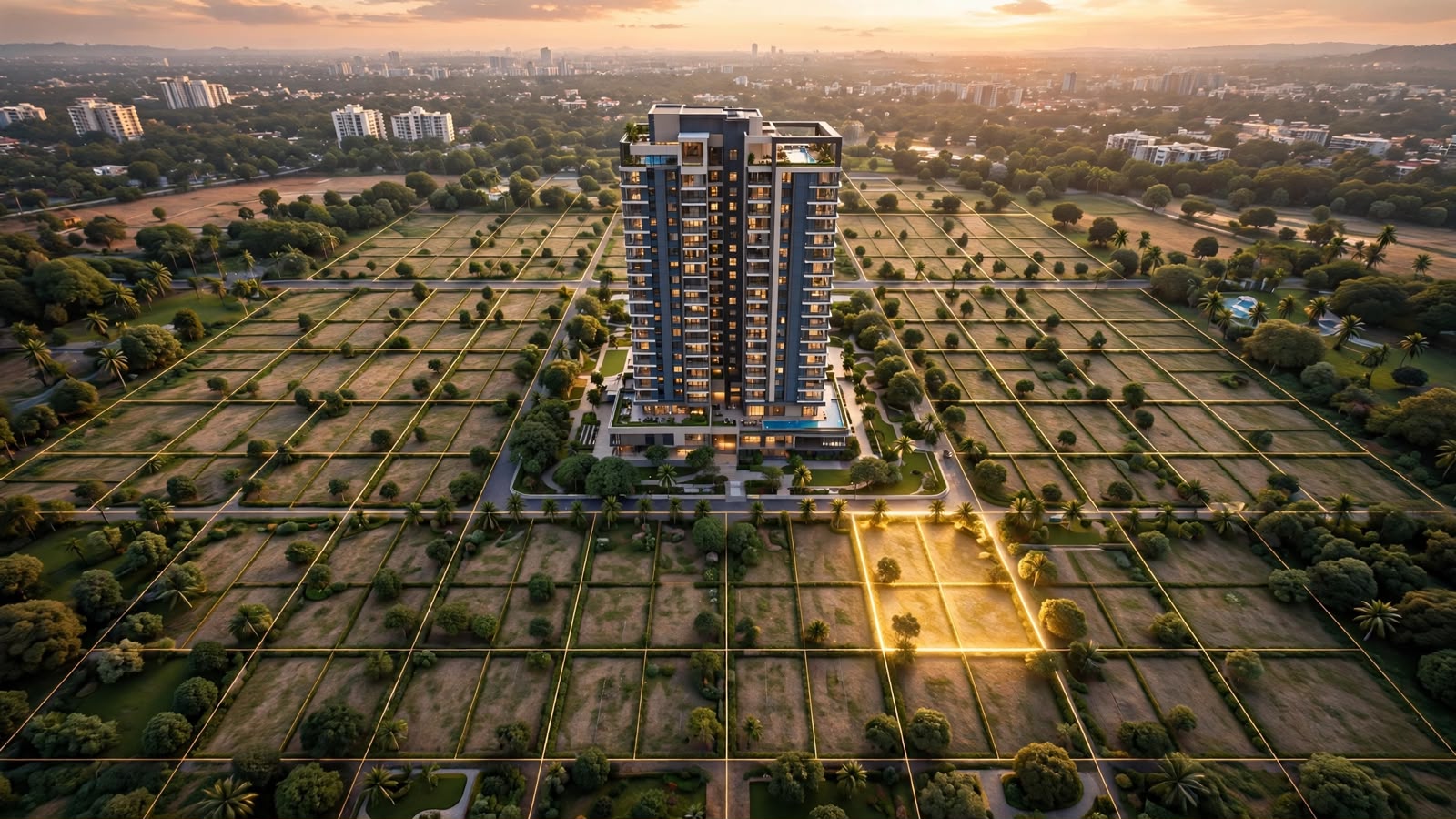
UDS in Bengaluru Apartments 2026: What Every Home Buyer Should Know Before You Buy
When you buy an apartment, you are not buying only the flat you can see.
You are also buying a share in the land on which the entire project stands.
That share is commonly known as UDS — Undivided Share of Land.
In Bengaluru’s apartment market, buyers often compare properties based on apartment size, price per sq.ft., amenities and builder reputation. But there is another number worth checking before you book:
“How much UDS am I actually getting?”
What is UDS? UDS is your proportionate undivided interest in the land and applicable common areas associated with your apartment.
You do not own a specific physical piece of land. Instead, you own an undivided share along with the other apartment owners.
For example, you cannot say, “This particular 300 sq.ft. portion of the land belongs to my apartment.”
Your ownership is a proportionate interest in the overall land.
The Karnataka Apartment Ownership Act provides for an apartment together with its undivided interest in common areas and facilities as transferable immovable property.
How is UDS calculated?
A commonly used proportional calculation is: UDS = (Your apartment area ÷ Total apartment area considered for allocation) × Total land area
Example Suppose:
* Total project land = 40,000 sq.ft. * Total apartment area considered = 1,75,000 sq.ft. * Your apartment = 1,500 sq.ft.
Then:
UDS = 1,500 ÷ 1,75,000 × 40,000
= 342.86 sq.ft.
So, the apartment could have approximately 343 sq.ft. of UDS, subject to the project's legal documents and the methodology used in those documents.
Important: Never rely only on a salesperson's calculation. Your lawyer should verify the UDS against the title documents, sanctioned plans, declaration, agreement and registered sale/conveyance documents.
Why does UDS matter?
Think of an apartment as having two broad economic components: Land + Building
The building gets older, requires maintenance and can eventually require major renovation or redevelopment.
Land is the underlying asset that cannot simply be created in the same location.
That makes UDS an important factor when evaluating an apartment for long-term ownership.
However, higher UDS does not automatically mean higher returns.
A property with higher UDS may still underperform if the location has weak demand, poor connectivity or limited resale potential.
Therefore, evaluate:
Location + UDS + Land Value + Demand + Rental Potential + Project Quality + Future Development
Potential advantages of higher UDS
1. Greater proportionate land interest A higher UDS represents a larger proportionate interest in the underlying land.
2. Relevant for future redevelopment If a building becomes old and redevelopment is considered, the underlying land ownership becomes particularly important.
3. Better comparison between apartments Instead of comparing only: “₹/sq.ft. — which apartment is cheaper?” also ask: “What land interest am I getting for my total investment?”
4. Useful in resale analysis For resale properties, buyers may consider UDS along with location, building age, condition, demand and documentation.
But UDS is NOT a guaranteed ROI formula
This is where many buyers make a mistake.
High UDS ≠ Guaranteed Appreciation
Your future return can be affected by:
* Location and infrastructure * Employment and connectivity * Rental demand * Purchase price * Construction quality * Building age * Maintenance costs * Financing costs * Market demand * Legal documentation * Future redevelopment possibilities
A property should therefore be evaluated as a complete investment, not on UDS alone.
The biggest apartment ROI mistake
Many buyers calculate:
Purchase Price → Future Sale Price = Profit
For example:
You buy an apartment for ₹80 lakh. Years later, you sell it for ₹1.10 crore.
It appears that you made: ₹1.10 crore − ₹80 lakh = ₹30 lakh
But that ₹30 lakh is not necessarily your actual investment profit.
You may also have paid for:
* Registration and transaction costs * Interiors * Loan interest * Maintenance * Property taxes * Repairs * Vacancy * Brokerage or selling expenses
Your real calculation should be based on total money invested versus net amount received on exit.
For a serious investment analysis, also consider the annualised return, rather than looking only at the rupee difference.
10 questions to ask before booking Before paying a substantial booking amount, ask:
1. What is the total land area? 2. What is my exact UDS? 3. How was my UDS calculated? 4. What is my carpet area? 5. What is my super built-up area? 6. What exactly is included in the quoted price? 7. What are the registration and other statutory costs? 8. What RERA details and approvals apply to the project? 9. What is the expected possession timeline? 10. Which documents should my property lawyer verify?
Also ask how your land and common-area interest is documented and how it may be treated if the building is redeveloped in the future.
Can an apartment create or destroy wealth?
An apartment can become a good long-term asset when the purchase price, location, demand, documentation, rental potential and ownership structure make financial sense.
But disappointing returns can occur when buyers:
* Overpay * Ignore transaction and holding costs * Assume guaranteed appreciation * Buy purely because of a famous brand * Ignore location fundamentals * Fail to examine title and UDS documentation * Calculate ROI without considering financing costs
The goal isn't simply to find an apartment that looks impressive.
The goal is to understand:
What am I buying? What am I paying? What do I actually own? What will it cost me to hold? And what could affect my future resale value?
When comparing Bengaluru apartments, look beyond the brochure:
UDS • Carpet Area • Super Built-up Area • Location • Builder • RERA • Approvals • Pricing • Rental Potential • Resale Potential • Total Acquisition Cost
Because the right question isn't simply:
“Which apartment looks the best?”
It is:
“Does this property make sense for my budget, purpose and long-term wealth plan?”
Disclaimer This article is for general educational purposes only and does not constitute legal, tax, financial or investment advice. UDS calculations and ownership rights can vary depending on the project's legal structure and documentation. Buyers should independently verify the title, approvals, sanctioned plans, agreement and sale/conveyance documents with a qualified property lawyer before purchasing.