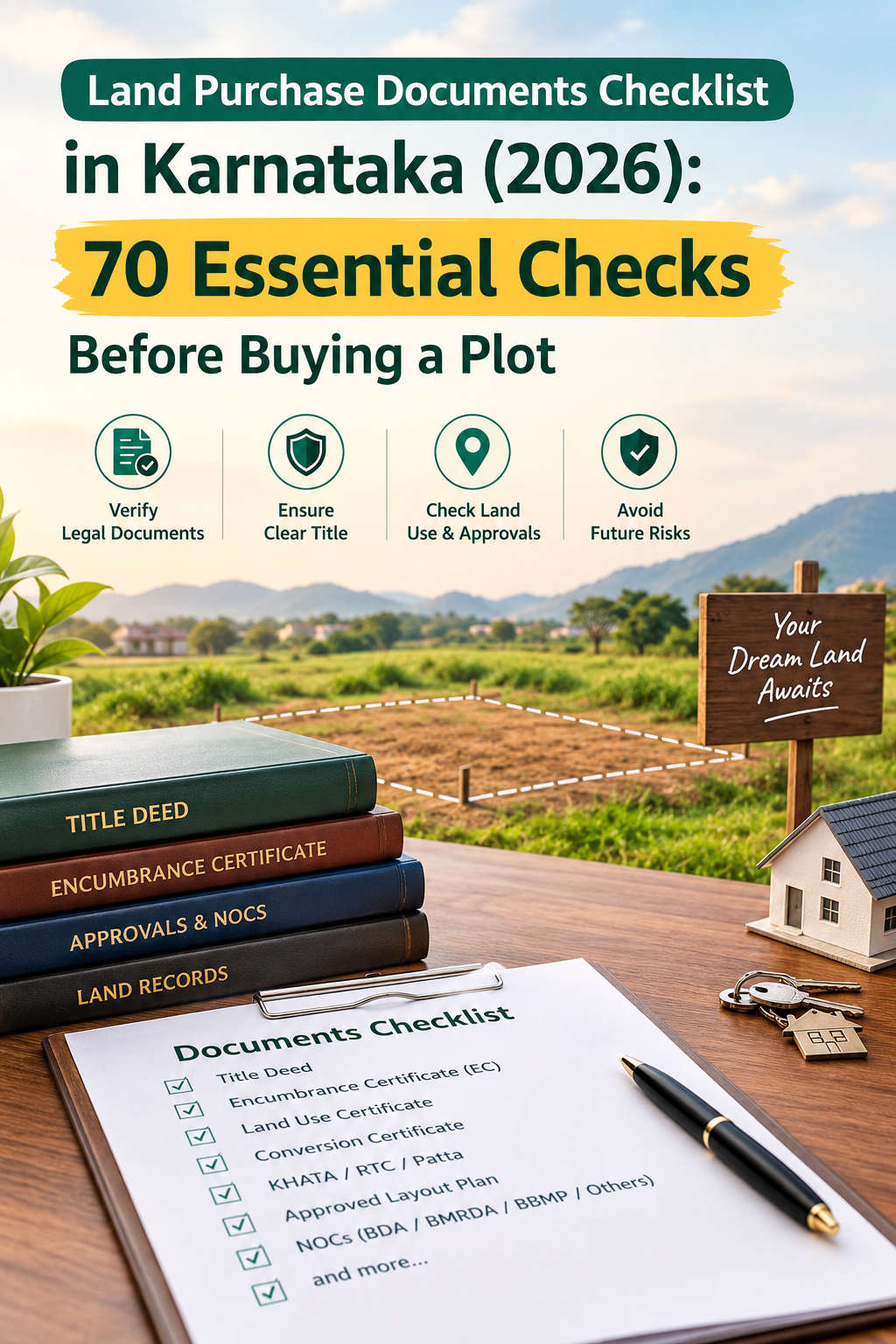
Buying an Apartment in 2026? The Complete Legal & Document Checklist Every Homebuyer Must Know
Buying an Apartment in 2026? 20 Documents Every Homebuyer Must Verify Before Paying
Buying an apartment is not simply a financial decision—it is a legal transaction involving land title, construction permissions, government approvals, RERA compliance, taxation, registration and your eventual ownership rights.
In 2026, an apartment buyer should never rely solely on a builder’s brochure, sales presentation or verbal promise. The project may look perfect physically, but the real question is:
“Is the land legally owned, is the building legally approved, is my apartment legally transferable, and will I receive clean title after registration?”
For buyers in Bengaluru and Karnataka, the following 20-document framework provides a practical due-diligence checklist.
⸻
1. Mother Deed / Parent Documents
The Mother Deed, also called the Parent Title Deed, establishes the historical chain of ownership of the land.
Do not look only at the developer’s latest sale deed. A lawyer should trace how the land moved from the original owner to subsequent owners and finally to the present landowner/developer.
Check: * Previous sale deeds * Gift deeds, partition deeds or release deeds, where applicable * Inheritance documents * Conversion-related records * Survey numbers and boundaries * Names of owners across the chain * Whether the property description remains consistent
Why it matters
A developer can have a registered document and still face problems if an earlier title in the chain is defective.
Golden rule: A registered document does not automatically mean that the underlying title is free from every legal defect.
⸻
2. Sale Deed / Title Deed of the Land
The current title document should establish who legally owns the land on which the apartment project is being developed.
If the developer does not own the land, determine whether the project is based on:
* Joint Development Agreement (JDA) * Development Agreement * Power of Attorney * Joint venture arrangement * Leasehold rights * Other legally recognised development rights
The buyer should understand who owns the land and who has authority to sell the apartment.
⸻
3. Encumbrance Certificate — EC
The Encumbrance Certificate is an important registration-related search document.
Karnataka’s Department of Stamps and Registration provides an online process for obtaining EC information for registered transactions from the relevant period.
An EC can help identify registered transactions/encumbrances such as:
* Sale transactions * Registered mortgages * Certain charges * Other registered instruments
But remember:
EC is not a complete title certificate.
An EC generally reflects registered transactions available in the registration system. It should therefore be combined with a proper title search, court/litigation checks and examination of original documents.
⸻
4. Land Conversion Order
In many cases, land originally classified as agricultural land must be legally converted for the intended non-agricultural/residential use.
For an apartment project, the buyer should establish:
What was the original land classification?
and
Was the land legally permitted for the present development?
Check:
* Conversion order * Survey numbers * Extent of land * Purpose of conversion * Conditions attached to conversion * Whether the present development corresponds with the permitted use
A project constructed on land with unresolved land-use issues can create significant problems later.
⸻
5. Approved Layout Plan
The layout plan shows how the overall property has been planned.
It may identify:
* Roads * Open spaces * Blocks/towers * Amenities * Parking * Utility areas * Setbacks * Common areas * Other development components
Important buyer question:
Is the sales brochure showing the same development that has actually been approved?
Never assume that a swimming pool, clubhouse, park, road or other amenity shown in marketing material automatically has the same legal status in the sanctioned plan.
⸻
6. Sanctioned Building Plan
The building plan is one of the most important documents for an apartment buyer.
It establishes what the competent planning authority permitted the developer to construct.
Check:
* Number of floors * Number of apartments * Building height * Setbacks * Parking * Floor plans * Built-up areas * Common facilities * Fire-safety requirements where applicable * Whether later modifications were properly approved
BBMP’s official building-plan system provides information relating to plan sanction, commencement certificates and occupancy certificates.
Major warning
If the developer constructs something substantially different from the sanctioned plan without proper approval, it can create legal and possession-related problems.
⸻
7. Commencement Certificate
The Commencement Certificate is permission to commence construction under the applicable local development regulations.
It is different from the Completion Certificate that may be issued after construction.
For a buyer of an under-construction apartment, verify that construction is being carried out under valid approvals.
For example, BBMP’s official records show commencement certificates being referenced as part of the approval history of apartment projects.
⸻
8. NOCs and Statutory Clearances
Large apartment developments can involve several regulatory authorities.
Depending on the location, size, height and characteristics of the project, relevant clearances can include:
* Fire and Emergency Services * Environmental clearance * Airport-related height clearance * Pollution control requirements * Water and sewerage approvals * Electricity-related approvals * Traffic/access-related permissions * Lake/wetland-related restrictions * Other local or sector-specific approvals
Not every project will require every clearance.
The correct approach
Do not ask:
“Does every apartment need all these NOCs?”
Ask:
“Which approvals are legally applicable to THIS project, and have they been obtained?”
⸻
9. RERA Registration
For applicable projects, RERA is one of the most important protections available to apartment buyers.
The central RERA Act requires prior registration of covered real-estate projects with the relevant Real Estate Regulatory Authority. It also regulates promoters, real-estate agents and buyer rights.
Before booking, verify the project’s:
* RERA registration number * Promoter name * Project name * Land details * Approved plans * Number of units * Completion/possession timeline * Litigation/disclosures * Project progress * Financial and other disclosures available on the authority’s portal
Never rely only on:
“RERA applied.”
You should verify whether the project is actually registered and whether the particular phase/tower/unit falls within that registration.
⸻
10. RERA Project Information vs Advertisement
RERA also deals with the promoter’s responsibility regarding the truthfulness of advertisements and prospectuses.
The buyer should compare:
Advertisement → Brochure → RERA disclosure → Approved plan → Agreement for Sale
If these contain materially different information, stop and investigate.
For example:
If the brochure says 1,500 sq.ft. but the legal agreement specifies a different carpet area, the agreement and legally relevant documents deserve careful examination.
⸻
11. Agreement for Sale
This is one of the most important documents you will sign.
Under Section 13 of RERA, a promoter cannot accept more than 10% of the cost of the apartment as an advance/application fee without first entering into a written agreement for sale and registering it as required by law. (India Code)
The agreement should clearly address:
* Apartment number * Carpet area * Price * Payment schedule * Possession date * Specifications * Amenities * Parking * Interest obligations * Default provisions * Cancellation provisions * Maintenance arrangements * Other contractual obligations
Do not sign blindly.
Read the entire agreement and have an independent property lawyer review it if the transaction is substantial.
⸻
12. Carpet Area vs Super Built-up Area
This is an extremely important point for buyers.
Under RERA, apartment transactions focus heavily on carpet area, rather than allowing buyers to be confused solely by super built-up figures.
When comparing two apartments, ask:
What is the RERA carpet area?
Then separately understand:
* Balcony/terrace area * Common-area loading * Super built-up area * Parking area * Undivided share of land
Example
Two apartments may both be advertised as “2,000 sq.ft.”
But their actual usable carpet areas may differ considerably.
Therefore:
Never compare apartment prices only on the advertised super built-up area.
⸻
13. Khata / Property Assessment Records
For Bengaluru properties, buyers commonly encounter terms such as:
* Khata * e-Khata * Property Register records * Property tax assessment records
These records are important for municipal/property-tax purposes.
However:
Khata is NOT the same thing as title.
A Khata record should not be treated as conclusive proof that the seller/developer has perfect ownership.
Therefore verify:
Title + EC + approvals + Khata/property records + tax records
as separate components.
⸻
14. Latest Property Tax Receipts
Check whether property taxes and applicable dues have been paid.
Verify:
* Property identification * Owner/khata holder details * Tax period * Outstanding dues * Property description
Do not assume that because a project is being sold by a reputed developer, every historical liability has automatically disappeared.
⸻
15. Occupancy Certificate — OC
For completed apartment projects, the Occupancy Certificate is extremely important.
It is issued by the competent authority under applicable local laws after examining whether the building can be occupied in accordance with the relevant approvals.
BBMP maintains official records of Occupancy Certificates for residential apartment buildings.
Buyer should check:
* OC number * Date * Project/building/block covered * Number of floors * Number of units * Whether the OC covers the building/block in which your apartment is located
Very important:
Do not simply ask:
“Does the project have OC?”
Ask:
“Does the OC cover MY building/block/tower and the relevant units?”
⸻
16. Completion Certificate
The Completion Certificate confirms completion of development/construction according to the applicable approved requirements, where such certificate is required.
Completion Certificate and Occupancy Certificate are related but are not automatically interchangeable terms.
The exact approval structure depends upon the applicable local authority and project.
RERA places responsibility on the promoter to obtain the completion certificate or occupancy certificate, or both, as applicable under local laws.
⸻
17. Sale Deed / Conveyance Deed
This is the document that ultimately transfers ownership.
For an apartment buyer, the conveyance should address:
* Apartment * Proportionate/undivided interest in common areas/land as applicable * Rights attached to the apartment * Common facilities * Other relevant ownership interests
RERA Section 17 provides for transfer of title through a registered conveyance deed and addresses transfer of proportionate title in common areas.
Never confuse:
Booking Form ≠ Agreement for Sale ≠ Sale Deed
They serve different purposes.
⸻
18. Undivided Share of Land — UDS
UDS is an extremely important concept in apartment ownership.
You don’t normally own the entire land underneath your apartment exclusively.
Instead, you receive an undivided proportionate interest in the land/common areas, depending on the legal structure of the project.
For example, if 200 apartments share a parcel of land, each apartment may have a proportionate undivided interest.
Why UDS matters
It can become particularly relevant in:
* Redevelopment * Reconstruction * Future redevelopment value * Land ownership * Association matters * Conveyance
The exact calculation and legal treatment should be checked against the project documents.
⸻
19. Apartment Declaration / Deed of Declaration & Association Documents
Apartment projects may have documents establishing:
* Common areas * Limited common areas * Apartment ownership rights * Percentage of common interest * Maintenance responsibilities * Association structure * Voting rights * Restrictions * Parking arrangements
After completion, understand how the owners’ association/society is structured.
RERA also recognises the role of the association of allottees, and buyers have obligations relating to participation in its formation.
Ask for:
* Association formation documents * Bye-laws * Maintenance agreement * Common-area handover documents * Facility/amenity obligations * Major pending dues or disputes
⸻
20. Registration, Stamp Duty and Final Ownership Records
Once the sale deed is executed, it must be properly registered with the competent registration authority.
In Karnataka, the Department of Stamps and Registration provides official information regarding stamp duty and registration-related matters and has systems for market-value and duty calculation. (IGR Karnataka)
The buyer should understand the applicable:
* Stamp duty * Registration fee * Market/guidance value implications * Other applicable statutory charges
The Karnataka department also publishes guidance relating to undervaluation and registration calculations. (IGR Karnataka)
Important:
Do not calculate your transaction cost only from the builder’s quoted apartment price.
Budget separately for applicable:
Stamp duty + registration + taxes/levies + maintenance/deposits + other transaction charges.
⸻
🚨 THE 10 BIGGEST MISTAKES APARTMENT BUYERS MAKE IN 2026
1. Checking only RERA
RERA registration is important, but it does not replace independent title and approval due diligence.
2. Believing “Khata = clear title”
Khata is not a substitute for title verification.
3. Looking only at the brochure
Marketing material is not the same as a sanctioned plan.
4. Paying a large booking amount before reviewing the Agreement for Sale
RERA Section 13 specifically restricts promoters from taking more than 10% before the required agreement is entered into and registered.
5. Checking EC but not the entire title chain
An EC is important, but it is not a complete legal title certificate.
6. Comparing apartments only by square feet
Compare carpet area, price per carpet sq.ft., UDS and total acquisition cost.
7. Accepting verbal promises about amenities
Get important promises into legally enforceable documentation.
8. Ignoring the sanctioned plan
A beautiful model apartment does not prove that the actual construction matches the sanctioned plan.
9. Taking possession without checking OC
For a completed project, establish whether the relevant building/block has the required occupancy approval.
10. Not obtaining independent legal advice
A builder’s lawyer protects the transaction from the developer’s perspective. An independent lawyer protects your interests.
⸻
🧾 THE IDEAL APARTMENT DUE-DILIGENCE ORDER
If I were creating a professional buyer’s checklist for a Bengaluru apartment purchase in 2026, I would examine the documents in this order:
STEP 1 — LAND
Mother Deed ↓ Parent Documents ↓ Current Title Deed ↓ JDA/Development Agreement, if applicable ↓ Power of Attorney, if applicable ↓ Conversion Order ↓ EC ↓ Litigation/title search
STEP 2 — PROJECT APPROVAL
Layout Approval ↓ Building Plan Sanction ↓ Commencement Certificate ↓ Applicable NOCs ↓ RERA Registration
STEP 3 — YOUR APARTMENT
RERA Carpet Area ↓ Apartment Number ↓ Floor Plan ↓ Parking Rights ↓ UDS ↓ Price & Payment Schedule ↓ Agreement for Sale
STEP 4 — COMPLETION
Completion Certificate, where applicable ↓ Occupancy Certificate ↓ Tax/Khata/property records ↓ Association formation ↓ Common-area handover
STEP 5 — OWNERSHIP
Final dues ↓ Stamp Duty ↓ Registration Fee ↓ Registered Sale/Conveyance Deed ↓ Possession ↓ Transfer/municipal records as applicable
⸻
🏆 THE “5-LAYER” RULE FOR BUYERS
Before purchasing an apartment, think of the property as having five separate legal layers:
Layer 1 — LAND
Who owns the land?
Layer 2 — DEVELOPMENT RIGHTS
Does the developer legally have the right to develop and sell?
Layer 3 — CONSTRUCTION
Was the building approved and constructed according to sanctioned plans?
Layer 4 — APARTMENT
Does the apartment being sold match the approved/RERA documents?
Layer 5 — OWNERSHIP
Will I receive a legally registered title/conveyance with the appropriate interest in common areas/land?
If all five layers are properly verified, your risk is substantially reduced.
⸻
A VERY IMPORTANT 2026 LEGAL PRINCIPLE
RERA should be viewed as a consumer-protection and regulatory framework, not as a replacement for a property lawyer’s due diligence.
The RERA Act itself gives buyers important rights and imposes duties on promoters, including requirements concerning project registration, sanctioned plans, agreements, possession, title transfer and completion/occupancy documentation.
The promoter is also responsible, under applicable law, for obtaining the required completion/occupancy certification and making it available to allottees.
⸻
FINAL APARTMENT BUYER CHECKLIST
Before making a major payment, ask your lawyer to answer YES to these questions:
☐ Clear chain of title ☐ Current ownership verified ☐ Development rights verified ☐ EC checked ☐ Land conversion verified where applicable ☐ Layout approved ☐ Building plan sanctioned ☐ Commencement permission verified ☐ Applicable statutory clearances verified ☐ RERA registration verified ☐ RERA disclosures match the project ☐ Carpet area verified ☐ Agreement for Sale reviewed ☐ Khata/property records checked ☐ Property taxes checked ☐ OC verified for the relevant building/block ☐ Completion documentation verified where applicable ☐ UDS/common-area rights understood ☐ Association/maintenance documents reviewed ☐ Sale/Conveyance Deed reviewed and registered
⸻
CONCLUSION
An apartment is not just four walls, a floor number and a car park.
You are buying an interest in land + building + common areas + development rights + legal title + contractual rights.
In 2026, the smartest buyer is not necessarily the person who gets the biggest discount.
It is the person who can answer:
“What exactly am I buying, who owns it, who approved it, what does RERA say, what will be registered in my name, and what happens if something goes wrong?”
Before purchasing a high-value apartment, use government portals and obtain certified/official copies wherever available, then have an independent property lawyer conduct title and approval due diligence.
A property may be beautiful on the outside. Its documents determine how safe it is on the inside.